Vegetables from Morocco: export varieties, seasons and supply
Tomatoes, bell peppers, onions: the vegetables from Morocco we export, their calendar, their sizes and what to specify when importing them.
vetafresh team
19 September 2026 · 6 min read
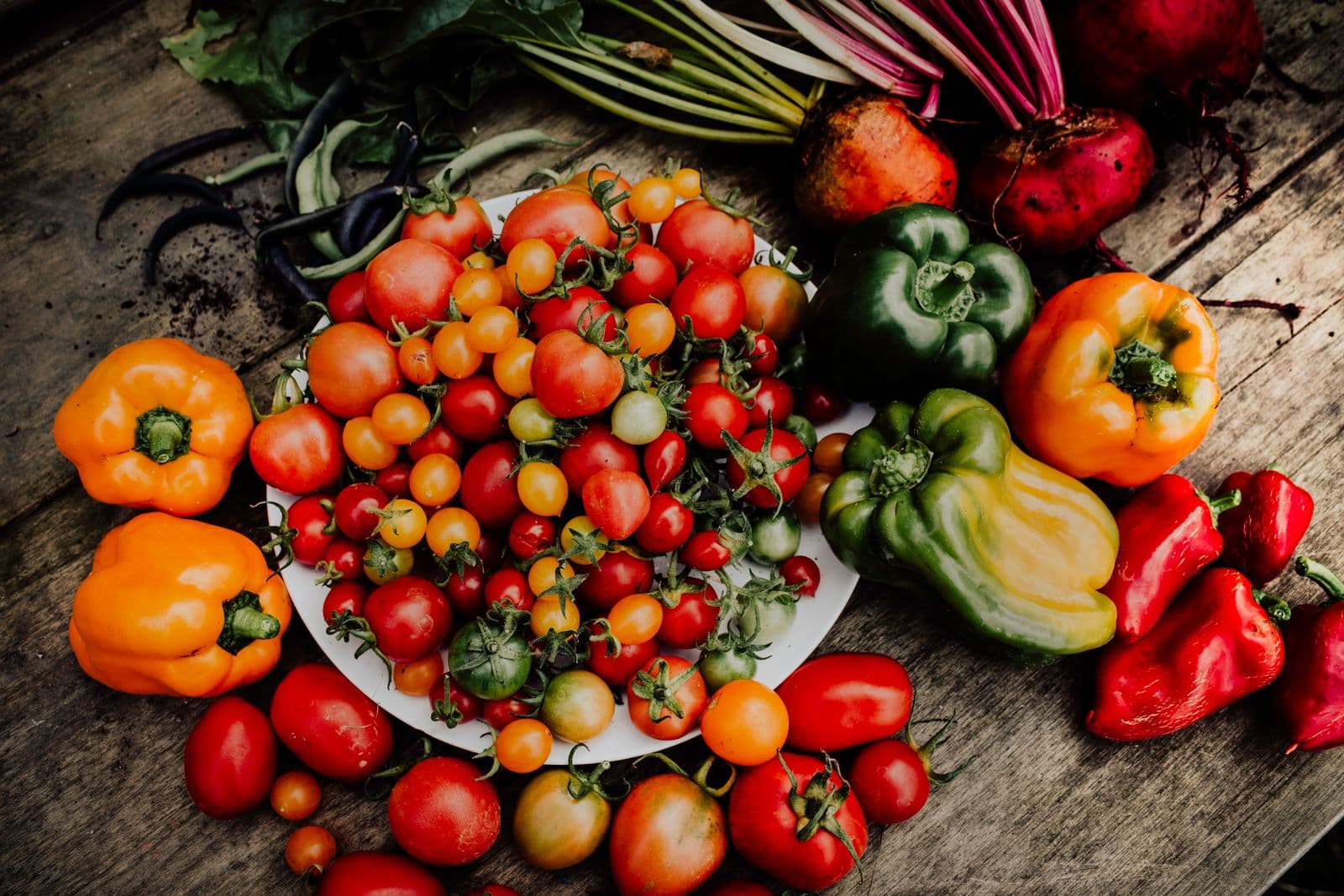
Vegetables from Morocco supply Europe for much of the year: tomatoes and bell peppers from autumn to early summer, with greenhouse tomatoes at the heart of winter, then onions from spring to autumn. For an importer, a wholesaler or a buying centre, Moroccan vegetables are a regular source of fresh produce, about four days' transit from Perpignan.
This guide presents the vegetables we export — types, sizes, packing, seasons — and what to specify when ordering them. vetafresh has exported fresh fruit and vegetables since 2009, from Aït Melloul in the Agadir region.
Seasonal calendar of vegetables from Morocco
The table below follows the seasons in our catalogue, product by product. Exact dates shift with each campaign's weather: every quote states current availability.
| Product | Jan | Feb | Mar | Apr | May | Jun | Jul | Aug | Sep | Oct | Nov | Dec |
|---|---|---|---|---|---|---|---|---|---|---|---|---|
| Vine tomato | available | available | available | available | available | available | available | available | ||||
| Cherry tomato | available | available | available | available | available | available | available | available | available | |||
| Cocktail tomato | available | available | available | available | available | |||||||
| Bell peppers | available | available | available | available | available | available | available | available | available | |||
| Yellow onion | available | available | available | available | available | available | available | |||||
| Red onion | available | available | available | available | available |
It reads simply: tomatoes and peppers cover winter and spring, onions summer and early autumn. By combining ranges, a buyer can keep a Moroccan vegetable programme running for much of the year with the same supplier.
Tomatoes
Morocco's leading vegetable export, the tomato is grown under cover in Souss-Massa from October to May. Our catalogue covers four types:
- vine, sold on the truss: standard vine (sizes M to L) from October to May, premium vine (L to XL) from November to April, in 5 kg cartons or 6 kg trays;
- cherry, round or plum-shaped, on the vine or loose, 18 to 25 mm in diameter, in 250 g punnets or 3 kg trays, from October to June;
- plum, with dense flesh, popular in food service;
- beef, a large, fleshy fruit made for slicing.
The vine tomato and the cherry tomato each have a product sheet in our catalogue; the cocktail tomato, an intermediate size, completes the offer from December to April. Every format is in the tomato range, and our guide to Moroccan tomatoes covers varieties, sizes, season and compliance in detail.
Bell peppers
Moroccan peppers are harvested from October to June, in three colours — green, red and yellow — within the same campaign. Two formats sit side by side:
- blocky peppers, four-lobed with thick walls, the standard retail format;
- pointed peppers, elongated, in demand in some markets and in food service.
The red bell pepper in our catalogue is a blocky pepper sized in the packing station, sizes L and XL, packed in 5 kg cartons. The other colours and the pointed format follow the same campaign; sizes and packing are set in the request. Like the tomato, the pepper is covered by a specific EU marketing standard that defines the Extra, I and II classes: state the class you expect. The full range is in the bell pepper range.
Blocky or pointed: which format?
The blocky pepper, regular and sized, sells by the piece or in multi-colour bags: it is the retail format. The pointed pepper, thinner and longer, goes mainly to food service and to markets where it is traditionally eaten. Both formats can be ordered within the same campaign.
Onions
Onions take over from April to October. They come from the Béni Mellal-Khénifra region.
- The yellow onion is a storage onion, field-cured then sorted and sized in the packing station. Its firm, golden skin copes with long transits. It ships from April to October, sizes 40–60 mm and 60–80 mm, in 25 kg or 10 kg net bags — 40 bags of 25 kg per pallet.
- The red onion, with purple flesh and a mild flavour, is available from May to September, size 50–70 mm, in 10 kg net bags or 5 kg cartons for retail.
See the onion range.
Growing regions
Tomatoes and peppers come from Souss-Massa, around Agadir, where most of Morocco's greenhouse vegetable production is concentrated. Protected cropping there allows harvesting all winter and control over ripeness at picking; tomatoes are sized and packed in the station less than six hours after harvest.
Onions come from the Béni Mellal-Khénifra region, at the foot of the Middle Atlas. For our fruit ranges we also work with the Gharb and the Oriental: the full picture is in our guide to fruits from Morocco.
Marketing standards and quality criteria
Tomatoes and peppers are covered by specific EU marketing standards that set the Extra, I and II classes, sizing tolerances and minimum quality requirements. Onions fall under the general marketing standard: produce that complies with the relevant UNECE standard is deemed to meet it.
Beyond the class, a specification often covers:
- for tomatoes: firmness, even colour within a pack and, for vine tomatoes, the condition of the stem and the number of fruits per truss;
- for peppers: colour, wall thickness and freedom from skin defects;
- for onions: dry, well-attached outer skins and a firm bulb, with no sprouting.
Food safety and EU compliance
The packing stations we work with are audited to GlobalG.A.P. for good agricultural practice and GRASP for working conditions. vetafresh also holds ISO 22000, BRCGS and EU Organic certification, and is approved by ONSSA, Morocco's food safety authority.
Every campaign includes a pesticide residue analysis that checks compliance with the maximum residue levels (MRLs) of the destination market. Every shipment leaves with:
- the phytosanitary certificate;
- the campaign's residue analysis report;
- the temperature record for the journey.
Traceability goes down to the lot: each pallet carries a number that links it to its plot of origin. Our article on pesticides and MRLs explains the system in detail.
Logistics and Incoterms
Departures are weekly from Agadir and Casablanca, as a full reefer for regular programmes or as refrigerated groupage for part loads and assortments. Transit to Perpignan takes about four days.
Not all vegetables travel in the same conditions. Tomatoes and peppers do not tolerate excessive cold: the set point is agreed at order and the cold chain is recorded end to end. Onions, by contrast, need a dry, ventilated atmosphere: they preferably ship separately from fresh vegetables.
We work from EXW to DDP, from the packing-station gate to customs-cleared delivery at your dock. Details of our services are on the Services page.
Frequently asked questions about vegetables from Morocco
Which vegetables does Morocco export in winter?
Mainly greenhouse tomatoes and peppers: October to May for tomatoes, until June for peppers. Onions take over from April to October.
Can tomatoes and peppers travel together?
Often, yes: both are chilling-sensitive vegetables with similar set points. The load plan is confirmed with the quote, depending on lot ripeness and journey time.
What sizes are available for tomatoes?
M to XL for round and vine tomatoes, 18 to 25 mm in diameter for cherry tomatoes. Plum and beef tomatoes are sized on request.
How long does delivery to Europe take?
About four days' transit to Perpignan, with weekly departures from Agadir and Casablanca.
How to source vegetables from Morocco
For a firm quote within 24 working hours, specify:
- the vegetable, type and colour;
- size, class and packing;
- volume, per week or per shipment;
- Incoterm: EXW, FOB, CFR, CIF, DAP or DDP;
- destination and delivery window.
Send your request through our quotation form or on WhatsApp at +212 708 275 517. To see every range at a glance, request the 2026 catalogue (PDF) or browse all our products.