Fresh produce traceability: tracing a carton back to the plot
6 min read
When a problem occurs, you need to find the plot, the harvest date and the customers of a lot within hours. What EU law, Moroccan law and buyers require, and the digital tools that make traceability fast.
vetafresh team
When a food safety alert hits a fresh product, the first question is always the same: where did this lot come from, and where did it go? Good traceability answers it within hours, recalls the right cartons and protects all the others. Here is what the law and buyers require, and how digital tools speed up the search.
In short
- EU law: every operator must know its supplier and its customer, "one step back, one step forward" (Regulation 178/2002, Article 18).
- Moroccan law: Law 28-07 requires traceability at every stage, under ONSSA supervision.
- Buyers: GLOBALG.A.P. requires each lot to be linked to the plot and tests the recall every year.
- United States: the FSMA 204 rule covers tomatoes, peppers and melons; enforcement is postponed to 20 July 2028 at the earliest.
The law
What the law requires
In the EU. Article 18 of Regulation (EC) 178/2002 requires traceability at every stage. Each operator must be able to say who supplied a product and to whom it was delivered, and the product must be labelled or identified to make this search easier. The rule does not apply outside the EU: the importer must identify the exporter, but traceability back to the plot is a matter of contracts and certifications. The marketing standard requires the packer's identity, the country of origin and a label on two sides of the pallet, but no lot number.
In Morocco. Law 28-07 on food safety requires traceability of primary products and foods at every stage. Establishments must be authorised or approved by ONSSA, and the authority can order a lot to be withdrawn. At export, ONSSA checks the documents, identity and labelling of lots, and takes samples for analysis.
The chain
From carton to plot, step by step
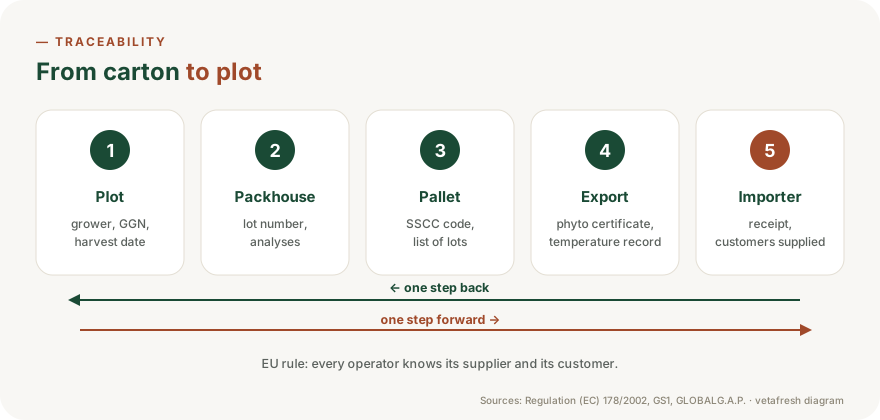
| Step | Information to link to the lot |
|---|---|
| Plot | Grower, GGN number, plot, treatments, harvest date |
| Packhouse | Packing date, lot number, size, residue analyses |
| Pallet | SSCC code, list of cartons and lots |
| Export | Phytosanitary certificate, transport documents, temperature record |
| Importer | Receipt, customers supplied, quantities |
Each vetafresh pallet carries a lot number traceable to the plot. For the information to print on cartons, see our labelling guide.
The tools
The digital tools
- GGN: a 13-digit number for each GLOBALG.A.P. certified grower; consumers can enter it on ggn.org.
- SSCC: an 18-digit number that identifies a pallet, encoded in GS1-128 on the logistics label, with the GTIN and the lot.
- GS1 Digital Link QR code: a single code that can carry the product, the lot and the date; the industry aims for wide adoption by the end of 2027.
- EPCIS 2.0: the GS1 standard that records each event, what, when, where and why, and lets partners share this data.
- ePhyto: Morocco has exchanged electronic phytosanitary certificates through the IPPC hub since 2020, and is among the countries whose electronic certificate is accepted in the EU TRACES system.
For the QR code, see our article on the GS1 Digital Link QR code.
Buyers
What buyers ask for
- GLOBALG.A.P.: traceability, one step back and one step forward, and a written recall procedure are major requirements; the recall must be tested every year.
- BRCGS: the standard expects a traceability test to be completed in about 4 hours.
- United States: the FSMA 204 rule requires a lot code from initial packing and records provided within 24 hours. It covers tomatoes, peppers, cucumbers, melons and herbs, among others. The FDA will not enforce it before 20 July 2028.
Other recent regulations do not concern fresh fruit and vegetables: the EU deforestation regulation covers seven commodities such as cocoa and coffee, and the digital product passport excludes food.
Recalls
When traceability makes the difference
In 2011, the E. coli O104:H4 outbreak in Germany caused 4,178 cases and 49 deaths; the investigation converged on a single lot of fenugreek seeds imported from Egypt. In 2024, in the United Kingdom, an E. coli O145 outbreak linked to lettuce affected 293 confirmed cases, but investigators could not identify which of the four growers or which plot was involved. By contrast, for a salmonella outbreak linked to cherry tomatoes from Sicily, still ongoing in 2026, the strain was found in one grower's irrigation water.
Our view. Good traceability is not judged on paper, but on how long it takes to answer. Ask your supplier for a test: give them a lot number and see how long it takes to find the plot, the harvest date and the analyses. Our aim is to answer within 24 hours.
The vetafresh team, Agadir
To avoid
Traceability mistakes
- Mixing several plots in one lot without recording it.
- Changing the lot number between packhouse and pallet without keeping the link.
- Keeping data on paper in several offices.
- Never testing the recall before you need it.
- Forgetting to link residue analyses to the lot shipped.
FAQ
Frequently asked questions
What is fresh produce traceability?
The ability to follow a lot from the plot to the customer, and back: knowing where it came from, how it was packed and to whom it was delivered.
What does Article 18 of Regulation 178/2002 say?
That every operator must know its supplier and its customer, one step back and one step forward, and that products must be identified to make traceability easier.
Is a lot number mandatory on a carton of fruit?
The EU marketing standard does not require it, but buyers and certifications almost always ask for it.
What is an SSCC?
An 18-digit GS1 number that uniquely identifies a pallet, printed as a barcode on the logistics label.
Does the FSMA 204 rule apply to Moroccan exporters?
Yes, for products sold in the United States and listed by the FDA, such as tomatoes or peppers. It will not be enforced before 20 July 2028.
Sources: European Commission, guidance on the implementation of Regulation 178/2002, 2010; Delegated Regulation (EU) 2023/2429; Moroccan Law No. 28-07, text, 2010; ONSSA, export certification of plant products; GS1, SSCC and logistics label, EPCIS and statement on QR codes, 2024; GLOBALG.A.P., GGN number and product recalls, July 2025; IPPC, ePhyto in Morocco, April 2020; Jordbruksverket, list of countries issuing electronic certificates valid in TRACES, August 2026; FDA, FSMA 204 rule and list of foods covered; Federal Register, postponement of the compliance date, 7 August 2025; EFSA, 2011 E. coli outbreak; UKHSA, E. coli O145 outbreak, December 2025; ECDC, Salmonella Strathcona, October 2026.
Want to test our traceability? Send us a lot number you received, or ask for a quote with your traceability requirements.