Optical sorting of fruit and vegetables: how a grader sorts a lot before export
6 min read
An optical grader photographs each fruit, weighs it, sometimes measures its sugar, then sends it to the right outlet. How it works, what it detects, its limits and what a buyer should ask.
Équipe vetafresh
Before export, a lot of clementines or tomatoes goes through a packhouse. On modern lines, an optical grader photographs each fruit from several angles, weighs it, detects its defects and sends it to the right size and class. Here is how this technology works, what it really measures and what a buyer can expect from it.
In 30 seconds
- The principle: each fruit rides in a cup, under colour, infrared and sometimes ultraviolet cameras, then over a weighing cell.
- Internal quality: a near-infrared spectrometer can estimate sugar (°Brix) or dry matter without cutting the fruit.
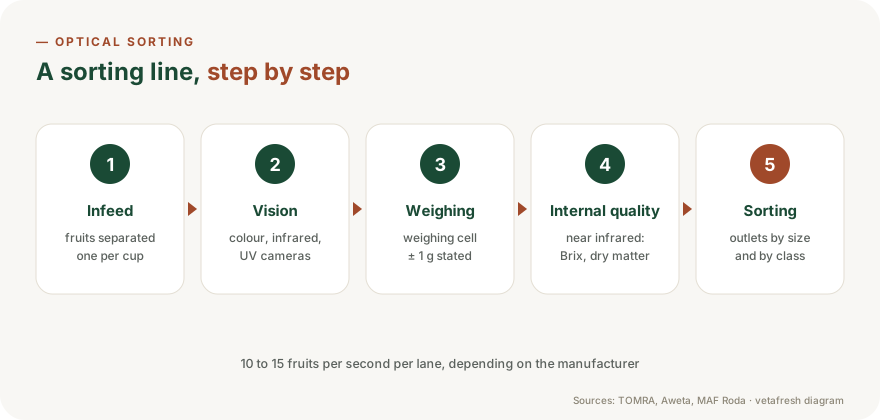
- Speed: around 10 to 15 fruits per second per lane, depending on the manufacturer.
- The limits: stated detection rates are manufacturer figures. In the lab, a plain colour camera is poor at detecting rot.
The principle
How an optical grader works
An optical sorting line always follows the same path. First, the fruits are separated and placed one by one in cups or on rollers that turn them. They then pass through a vision chamber, where several cameras photograph them under controlled lighting. A cell weighs each fruit. The software then decides its outlet: size, class, or reject.
| Sensor | What it measures |
|---|---|
| Colour camera | Colour, shape, diameter, visible skin defects |
| Infrared camera | Defects hard to see with the eye, such as some rots or bruises |
| Ultraviolet light | Early rot in citrus, through fluorescence of damaged skin |
| Weighing cell | Weight of each fruit |
| Near-infrared spectrometer | Sugar (°Brix), acidity, dry matter, some internal defects |
Manufacturers such as TOMRA, Aweta, MAF Roda, Unitec and Ellips now add artificial intelligence. The software learns to recognise each type of defect from thousands of images, and gives each fruit a defect class and a severity level.
By product
What the machine looks at for each fruit
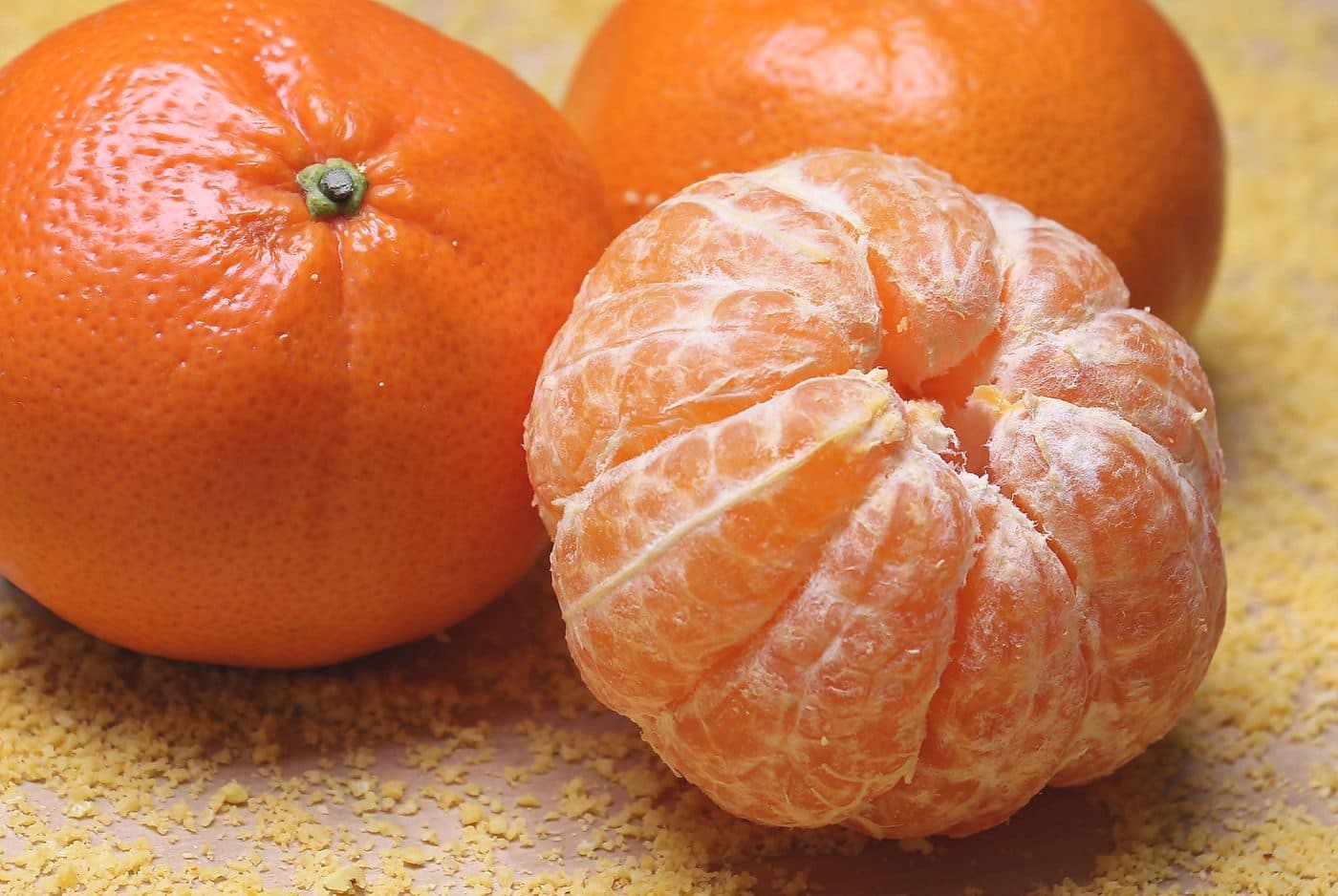
- Citrus: blemishes, sunburn, wounds, long stems, and above all rot. Ultraviolet light reveals damaged skin on clementines and oranges, but not on lemons.
- Tomatoes: colour, from green to red, diameter, cracks and irregular shapes.
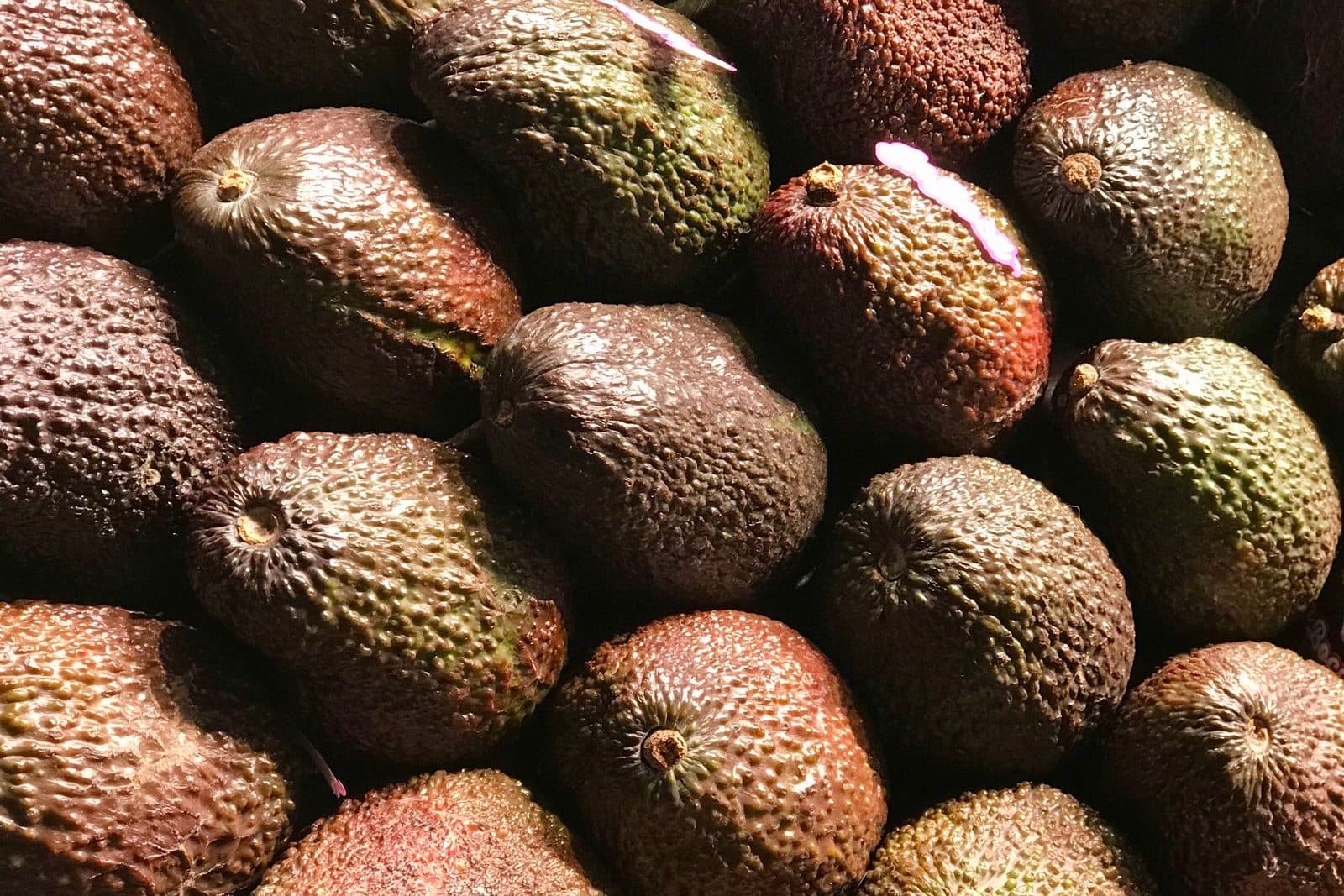
- Avocados: size by weight and, with a spectrometer, dry matter, the most widely used maturity indicator.
For citrus, see our article on clementines. For avocados, see avocado exports from Morocco.
The limits
What the machine does not guarantee
Manufacturers often claim more than 99% of defects detected. These are sales figures, with no published protocol. Independent studies are more nuanced:
- Citrus rot: a colour camera alone detects less than 60% of it in the lab. Multispectral or hyperspectral imaging reaches 90 to 98%.
- Ultraviolet: not all rotten areas react, and a simple scratch can be mistaken for rot.
- Avocado dry matter: the near-infrared measurement error is about 1.2 to 1.6 points. Near a 24% threshold, a fruit can be misclassified.
- Very uniform lots: when all the fruits look alike, a small measurement error is enough to sort them wrongly.
The machine reduces manual sorting, it does not remove it. Visual checks and sampling are still useful.
The standard
From machine size to regulatory size
The grader measures diameter and weight, then puts each fruit in a size class. In the EU, the classes are set by Delegated Regulation (EU) 2023/2429. For citrus, the size codes overlap: a 60 mm clementine can fall into code 2 (58 to 69 mm) or code 3 (54 to 64 mm), so the machine's program sets the limit. Within a package, the difference in diameter is limited, for example to 10 mm when the smallest fruit is under 60 mm. For size labelling, see our guide to package labelling.
In Morocco
Optical sorting in Moroccan packhouses
Moroccan citrus and tomato packhouses use automatic graders, and packing machinery makers have branches in Morocco, notably in Agadir and Berkane. Public data remain scarce: few packhouses detail their equipment, and no source lists the country's optical graders. Our products are packed in partner packhouses audited to GlobalG.A.P. and GRASP. Ask us about the equipment of the packhouse that will prepare your lot.
Our view. An optical grader gives more consistent lots and faster sorting, but it does not replace a precise specification. Write down the size, class, colour and, if needed, a minimum Brix or dry matter. And ask the packhouse how it sets up the machine and how it checks the sorting.
The vetafresh team, Agadir
To avoid
Common mistakes about optical sorting
- Taking a detection rate stated by a manufacturer as a guarantee.
- Assuming that ultraviolet light detects rot in lemons.
- Requiring a dry matter threshold without allowing for measurement error.
- Forgetting that size codes overlap: state the range you want.
- Dropping all visual checks because the packhouse is equipped.
FAQ
Frequently asked questions
What is an optical grader?
A machine that photographs each fruit with several cameras, weighs it, detects its defects and sends it to the outlet that matches its size and class.
Can a machine measure the sugar in a fruit?
Yes, with a near-infrared spectrometer, which estimates Brix or dry matter without cutting the fruit. The measurement is still an estimate, with a margin of error.
How many fruits does a grader sort?
Around 10 to 15 fruits per second per lane, depending on the manufacturer. A large multi-lane line exceeds 100 fruits per second.
Does optical sorting detect rot?
Partly. Infrared and multispectral cameras and ultraviolet light help a lot, but no method detects everything.
Does optical sorting replace quality control?
No. It reduces manual sorting, but visual checks and sampling are still needed, both at the packhouse and on arrival.
Sources: TOMRA, Spectrim platform, 20 January 2016, rot detection, 29 June 2017, and the LUCAi for citrus page; FreshPlaza, Aweta 3D vision for citrus, 21 July 2017, MAF Roda, 8 March 2021, and AI citrus sorting, 3 September 2026; Citrus Industry, IMG Citrus packinghouse, 17 September 2019; Ellips, AI citrus sorting, 27 May 2025; Cai et al., citrus rot detection, Frontiers in Plant Science, 2022; Rodríguez et al., avocado dry matter by near infrared, Plants, 2023; Wedding et al., FT-NIRS on Hass avocado, 2009; Walsh, Golic and Greensill, near-infrared fruit sorting, Journal of Near Infrared Spectroscopy, vol. 12; Delegated Regulation (EU) 2023/2429, citrus and tomato standards. Performance figures stated by manufacturers are not independent results.
Want consistent lots? State size, class and internal criteria in your request, and we will tell you which partner packhouse can meet them.