Temperature data logger: monitoring the cold chain for fruit and vegetables
7 min read
A temperature data logger is the only proof of the cold chain in a dispute. Device types, placement in the truck, rules for fruit and vegetables and reading the curve: the practical guide.
Équipe vetafresh
Between a packhouse in Agadir and a European warehouse, a load of fruit spends several days in a refrigerated trailer. If the temperature drifts, only a temperature data logger shows when, for how long, and who should answer for it. Here are the available devices, where to place them, what the law says and how to read the curve.
In short
- The devices: single-use logger read by USB, real-time connected tracker, reefer unit recorder, core probe.
- The placement: the rear of the trailer, by the doors, is usually the warmest zone.
- The law: for fresh fruit and vegetables, no logger is mandatory; it is a tool of proof.
- The claim: written reservations within 7 days for non-apparent damage, under the CMR convention.
The devices
Which logger for which need?
| Device | What it does | When to choose it |
|---|---|---|
| Single-use logger (USB, PDF) | Measures air temperature every 30 s to 15 min; the curve is read on arrival | Simple, low-cost proof for every shipment |
| Connected tracker (4G, 5G) | Sends temperature, humidity, location and sometimes door openings every 15 to 20 min; alerts by SMS or email | High-value loads, long trips, need to act during transport |
| Reefer unit telematics | Tracks the set point, supply and return air, the doors and the truck's location | Provided by the carrier, useful to check the setting |
| On-board EN 12830 recorder | Records the air in the trailer body, prints a ticket | Standard equipment on many trailers |
| Core probe | Measures the temperature inside the fruit, at a given moment | At loading and at receipt |
The accuracy stated by manufacturers is often ± 0.5 °C within the working range. Note: common loggers measure temperature, sometimes humidity and light, but not ethylene; ethylene sensors are still at the research stage.
The placement
Where to place the logger?
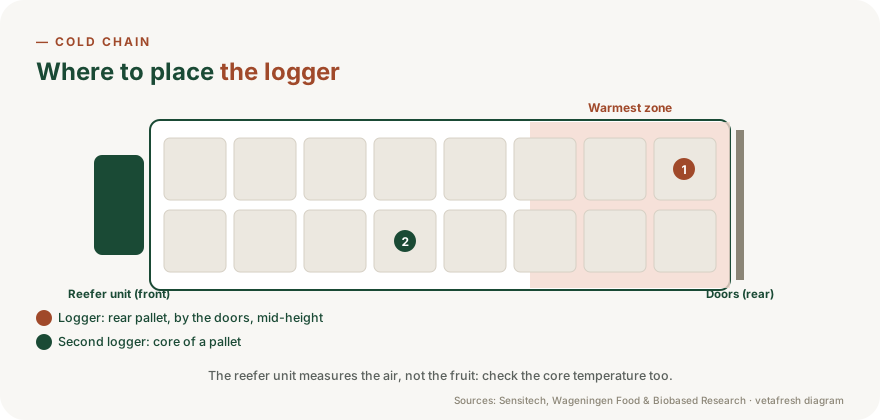
The reefer unit measures the air it blows out and the air that returns, not the temperature of the fruit. Inside the trailer, the differences are often larger than expected: a field study with 40 sensors in a refrigerated container found much larger variations than anticipated. Modelling by Wageningen also shows that the core of the pallets stays warmer than the outer layers, and that the air warms up faster than the fruit during a power cut.
- Place at least one logger on a rear pallet, by the doors, at eye level.
- If the load is valuable, add one at the front and one in the core of a pallet.
- Start the logger at loading and write its number on the transport document.
- Measure the core temperature of a few fruits at loading: a refrigerated truck maintains temperature, it does not quickly cool down warm produce.
The law
What the regulations require
For quick-frozen foods, recording the air temperature is mandatory in the EU, with devices that comply with the EN 12830 standard and records kept for at least one year. For fresh, unprocessed fruit and vegetables, this is not the case:
- ATP: the international agreement on the carriage of perishable foodstuffs does not cover fresh, unprocessed fruit and vegetables.
- Hygiene: Regulation (EC) 852/2004 requires temperature control during transport, without setting a value or a device.
- EN 12830: the standard for transport loggers; a compliant device is a mark of reliability, and the EN 13486 standard governs its periodic verification.
For a fruit and vegetable importer, the logger is therefore a commercial tool and a means of proof, not a legal obligation.
The claim
Using the curve in a dispute
A logger's curve shows three things: the temperature at departure, the stability during the trip and the deviations, with their time and duration. A slow rise over several hours says more than a single reading on arrival.
- Written instructions: write the temperature, ventilation and humidity on the order and on the CMR consignment note. Under Article 18 of the CMR convention, the carrier of a refrigerated vehicle must prove that it properly used the equipment and followed the instructions received.
- Reservations: apparent damage is noted at delivery; non-apparent damage is reported in writing within 7 days, excluding Sundays and public holidays (Article 30).
- Time limit for action: 1 year under the CMR, 3 years in case of wilful misconduct.
- Incoterm: it sets the transfer of risk, not the quality criteria; add a separate clause. See our guide to Incoterms.
For alert thresholds, start from the sensitivity of the product: a tomato, for example, suffers from a prolonged stay below 10 °C. For the inspection method on arrival, see our guide to quality control at receipt.
In Morocco
The Agadir – Europe route
From Agadir, the refrigerated truck reaches Perpignan in about 4 days, with a Tanger Med – Algeciras crossing. Each transshipment is a risk of a temperature break: it must appear on the record, with its time. Single-use loggers and low-cost connected trackers are offered to Moroccan exporters. Every vetafresh shipment leaves with a temperature record, and we follow shipments to destination: see transporting fruit and vegetables from Morocco.
Our view. A logger costs little compared with a rejected truckload of fruit. Put one in every shipment, place it by the doors, write the set point on the CMR consignment note and read the curve again before signing the delivery note. If there is a deviation, the curve and precise reservations make the difference.
The vetafresh team, Agadir
To avoid
Common mistakes with a logger
- Forgetting to start the logger at loading.
- Placing it against the cold air outlet, at the front: it will not see the warmest zone.
- Relying on the reefer unit display, which measures the air and not the fruit.
- Signing for delivery without reservations before reading the curve.
- Not writing the temperature set point on the CMR consignment note.
FAQ
Frequently asked questions
Is a temperature data logger mandatory for fruit and vegetables?
No, not for fresh, unprocessed fruit and vegetables. It is mandatory for quick-frozen foods. For fruit and vegetables, it is mainly proof in case of a dispute.
Where should the logger go in a refrigerated truck?
On a rear pallet, by the doors, at eye level: this is usually the warmest zone. Add a second device in the core of a pallet for a high-value load.
What is the difference between a logger and a connected tracker?
The logger is read on arrival. The connected tracker sends readings and location during the trip and triggers alerts, so you can act before arrival.
What is the EN 12830 standard?
The European standard for temperature recorders used in transport and storage. It is mandatory for quick-frozen foods and serves as a reliability benchmark for other products.
How long do you have to dispute temperature damage?
Non-apparent damage must be reported in writing to the carrier within 7 days, excluding Sundays and public holidays, under the CMR convention.
Sources: technical data sheets for Sensitech TempTale Ultra (2020), DeltaTrak FlashLink, Emerson GO and Tive Solo 5G; Carrier Transicold, Lynx Fleet, 24 April 2024, and DataCold 300; Thermo King, TracKing and TouchPrint; Kumar et al., ethylene sensors, Royal Society of Chemistry, 2025; EN 12830:2018 standard and EN 13486:2023 standard; Regulation (EC) No 37/2005; Regulation (EC) No 852/2004; ATP agreement, ECE/TRANS/347; Lang, Janßen and Jedermann, sensors in a refrigerated container, SENSORNETS, 2014; Wageningen Food & Biobased Research, report 2279, April 2022; Sensitech, logger placement; FAO, The State of Food and Agriculture, 2019; UC Davis Postharvest, tomato; CMR convention, French text; FreshPlaza, temperature monitoring in Morocco, 19 October 2023. Device specifications are those stated by the manufacturers.
Want temperature monitoring on your shipments? State the set point and your recording requirements in your quote request.